
The Integration Layer - All the Gears. One Mechanism. #53
You are not a collection of broken parts; you are a mechanism. Week 53 explores why integration isn't about perfect harmony, but the honest coexistence of every gear you've forged and inherited. Stop trying to fix what isn't broken. Adjust the alignment and let the watch tell time. 🧅


You Are Not a Collection of Parts. You Are a Mechanism.
A watch doesn't tell time because its gears are beautiful.
It tells time because every gear — the small ones, the worn ones, the ones inherited from the original design — functions together as an integrated system. Remove one gear and the whole thing stops. It doesn't matter how perfectly the other parts are calibrated. The mechanism requires all of it.
Paul Chek puts it plainly: the sum of the parts does not equal the whole. The whole of the parts must function together as an integrated system for the mechanism to work.
That's not a metaphor for a better version of yourself. That's a description of the one that already exists — gears and all.
The Parts You Didn't Choose
Some of your gears were installed before you had a say.
The impatience that rises before you can stop it. The way your father's voice comes out of your mouth in moments of frustration. The programming that runs underneath the man you've deliberately built — quietly, automatically, surfacing in the moments you least expect it.
Those aren't defects. They're inherited gears. Installed by people who were doing the best they could with what they were given. That's not an excuse. That's mechanics.
The integration work isn't removing those gears. It's understanding how they function — and calibrating them consciously instead of letting them run on the original setting.
You caught it with your son. You raised your voice — short tempered, the old programming running — and you saw the synapse forming in his eyes. He's two years old. You stopped. You picked him up, apologized, asked about his feelings, and chose differently in real time. Breaking the cycle not in theory. In the moment.

That's not a small thing. That's a gear being recalibrated by a man who knew the difference — because he'd done the work to know.
The Parts You Built
Then there are the gears you forged deliberately.
The one that post this newsletter every Thursday without negotiating. The one that sits with a client and delivers real results — not vanity metrics, not click farms, but actual people walking through the door because the work was honest. The one that caught himself mid-moment with his son, stopped, corrected his behavior, picked him up, and chose differently.
The man at the desk before his part of the world wakes up. The man on the beach in prayer at sunrise. The man who drove to Miami this weekend looking for one thing and came back with something more useful — clarity about what the next chapter actually is, not what he wished it would be.
Some of these gears grind against each other. The creative work and the financial pressure don't always run smoothly. The trust in the path and the weight of real responsibility aren't always reconciled by sunrise. The younger version of me who left Miami to forge his own path, and the quiet pull toward what was left behind — that tension is real and still running. For now, the path forward is the one already being walked.
That's not a failure of integration. That's what integration actually feels like. Not harmony. Honest coexistence. All the parts in the mechanism, doing their job, even when the friction is real.

The Integration Truth
Here's what 53 weeks of honest documentation has produced:
Not a finished story. Not the acceptance from people still seeing a version of you that no longer exists.
Just a man who knows his own gears. Who can feel the inherited ones running and choose, in real time, whether to follow them or calibrate them. Who has assembled enough of the mechanism to recognize what it was always built for.
Someone once asked on a podcast — what would you tell your 18-year-old self?
Nothing. Or I wouldn't be here.
That's the integration. Not arriving somewhere cleaner or easier or more resolved. Just becoming, finally, the whole mechanism — gears inherited and forged, calibrated by choice, running in honest relationship with each other.
The watch doesn't tell time despite its complexity. It tells time because of it.
Still here. Still calibrating. Still becoming. 🧅
Let go. Let God. The mechanism was never broken. It was always becoming whole.


Want to write through these same layers and make them your own?

The "Being Coached" Layer: The Restoration of Order
Dr. Goodman shifts the entire paradigm of the struggle: you cease to fight the moment you realize there is nothing fundamentally broken to fix. When you stop trying to force a repair on yourself, you naturally step into the role model your wife and son actually need. You aren't modeling a flawless performance — you are modeling how to drop the armor and embrace a deeper divine order. The hope for your son isn't that he copies your exact steps, but that he watches your path of self-discovery and learns how to navigate his own. By ceasing the struggle, you give him the ultimate inheritance: the blueprint of a man who knows how to trust the design.
This connects directly to the core of chiropractic principle — the sum of the parts does not equal the whole. Friction only happens when the system gets out of order and needs to be regulated again. Returning to alignment doesn't require a total rebuild. It requires an adjustment. An adjustment is the restoration of order — nothing more. When you recognize that your internal friction isn't a structural defect, you stop the panicked troubleshooting, clear the subluxation, and guide the stuck gears back into place. That is the moment the mechanism syncs up. And then — as Dr. Goodman put it — you can finally tell time⌚️.
The Takeaway for You: Stop treating your internal tension as a design flaw. You are not a collection of broken pieces — you are an integrated system that occasionally gets out of alignment. When the impatience rises or the gears grind, don't try to rip them out. Step back. Perform a conscious adjustment. Restore the order. Cease the struggle. Allow the divine order to do what force never could. Let the mechanism run the way it was always designed to — and then you can finally tell time.
Bookshelf Peeled - The Calibration of the Whole
In No Bad Parts, Richard Schwartz introduces Internal Family Systems (IFS), a psychological framework built on a liberating truth: your mind isn’t a single, monolithic entity. It is a system made up of different "parts," or sub-personalities. More importantly, Schwartz argues that there are literally no bad parts. Every protective instinct, every flash of inherited impatience, and every defensive habit was originally formed to keep you safe. The system misfires not because these parts are defective, but because they get locked into extreme, outdated roles when they aren't integrated by your true, core Self.
This completely cracks open the mechanics of Week 53. When your father’s voice comes out of your mouth, or when creative drive violently grinds against financial responsibility, it isn’t a sign of failure. Those aren't broken components you need to rip out of your chest; they are simply inherited or defensive gears running on old factory settings. Integration means stepping in as the conscious engineer—the core Self—to acknowledge why those gears exist, soothe the friction, and recalibrate them to work with the rest of the mechanism instead of letting them hijack the whole clockwork.
The Takeaway for You: Stop trying to fix yourself by eliminating your flaws. The parts of you that feel defensive, impatient, or weary aren't defects; they are just gears that have been carrying a heavy load for a long time. True integration is recognizing that the mechanism doesn't need to be replaced—it just needs to be led. When the friction rises, stop fighting the parts that are struggling, understand their placement in the system, and let the core Self turn the wheel.
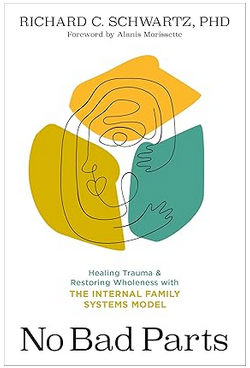
No Bad Parts: Healing Trauma and Restoring Wholeness with the Internal Family Systems Model
By Richard Schwartz PhD
Design Rebel: All the Gears. One Mechanism.
This week, inspired by Paul Chek, this piece explores why true integration isn't about perfect harmony—it's about the honest coexistence of every gear you've forged and every inherited trait you carry running together as one functional system —like a fine timepiece.
The Tech: Visuals were custom-generated using Leonardo.ai and Veo 3.1, then meticulously paced and manually edited within Wondershare Filmora to control the narrative rhythm. The gritty, deep voice, slight accent, voiceover was produced via ElevenLabs, delivering a heavy hitting script written by Martin Casado and structured by Gemini.
How to Integrate Your Complexity | The Rebel Onion Week 53
This Got Me Thinking:
The darkness you were handed wasn't a defect in the mechanism. It was the gear the whole thing needed to finally tell time. Saw this and it resonated for this week.

P.S. If this resonates with you, share it with someone. I'm dedicated to helping fellow explorers—or anyone who found this page—uncover their authentic self with humor and insight. We're all in this together, finding the courage to truly live from our core essence (or as close as we can get!).
The Essence Layer: What Remains When Everything Else Falls Away
 Follow
Check out my book I wrote on Amazon by Martin Casado