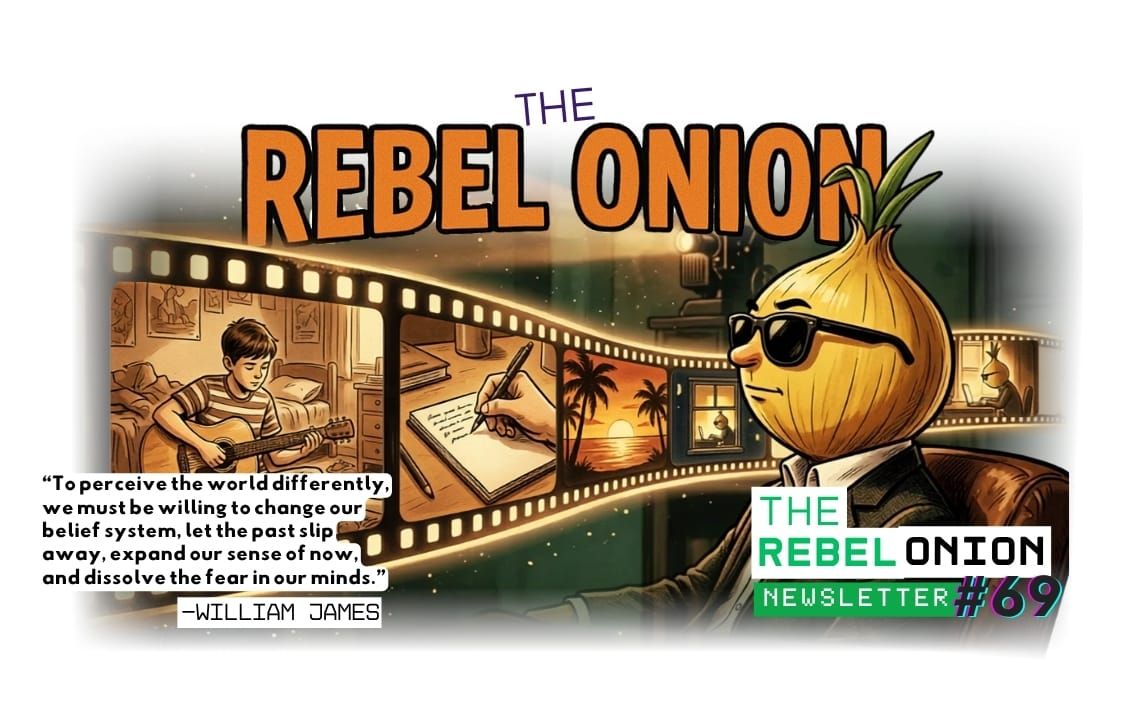
The Instrument Layer: The Part of You AI Can't Finish #69
Flow isn't a productivity hack; it's medicine. Week 69 explores disappearing into your craft, the unrecycled human signal AI can’t replicate, Dr. Larry Goodman on the remake trap, and why craving the disappearance is how you unearth what only you can create.

A great violinist disappears into the music.
You watch and you can't tell where she ends and the sound begins. She's not performing anymore. She's not thinking about her fingers. There is no observer separate from what's happening. The violin is playing. She's the instrument the music is playing through. And the violin, honestly, is just the instrument SHE is playing through. The dissolve goes all the way down.
When the work is truly happening in you, where do you go?
Twenty-Five Minutes I Wasn't There
Here's the receipt.
Sometimes I sit down at 6am on Tuesday, open the doc, and start answering the question of the week. Not writing. Answering. And somewhere between minute five and minute thirty, something opens. Time collapses. I look up and my body says twenty-five minutes have passed. My screen has five paragraphs on it. I remember the words. I don't remember Martin choosing the words. They showed up already assembled through my hands.
That's not a productivity high. That's a small disappearance.
The Martin who checked the clock is not quite the same Martin who was writing. Both are me. But they're not identical. Something happened in the twenty-five minutes and the second Martin knows things the first one didn't. Not because he thought about them. Because they moved through him while he was gone.
Every maker knows this state. Musicians in the pocket. Athletes in the zone. Buddhists call it no-self. Csikszentmihalyi called it flow. Every tradition has a name for the same physics. You dissolve. Something makes itself through what used to be you.
Signal in the Point-Zero-Zero-Nine
Here's a specific thing I know because of when I grew up.
I'm Xennial. Analog childhood, digital adolescence, smartphone adulthood, AI middle age. I watched every technology arrive one at a time. Cassette to CD to compressed MP3 to streaming. Beeper to flip phone to smart phone to always-on. Each step promised MORE and quietly delivered LESS of the actual signal. Compression is the through-line. Convenience costs you the depth you didn't know was in the original. Call it point-zero-zero-nine percent. Made-up number, probably has a lot more zeros. But you know the thing I mean. You don't notice one compression. Fifteen compressions later you can't remember what music used to sound like.
The same is true of thinking now. LLMs are trained on almost everything we've ever written. They regurgitate what we've already said back at us in cleaner packaging. Jordan Peterson has a line about post-modern books all just parroting each other's ideologies. Which is what we're doing with those books too. Reading the same authors, quoting the same lines, performing the same ideas at each other in coffee shops trying to sound like the smartest person in the room. AI just automated the loop. That's most of the internet now, run through a smoothing filter until it all sounds the same. Anthropic and OpenAI know this. And what they're actually hunting for, the reason they care about this technology existing at all, is that same point-zero-zero-nine. The tiny fraction of human output that isn't predictable. The part that couldn't be finished by anyone else.
That fraction is what flow makes.
When you disappear into the work, the thing that comes out is the part of you the machine can't finish for you. Because it's not coming from you exactly. It's coming through you from somewhere the pattern-recognition can't reach yet. The predictable part gets copied. The disappearance part doesn't. That's the whole moat.
Which means flow isn't just personally useful. It's the last remaining source of unrecycled signal in the world.
Wisdom Without the Charge
Here's the part almost nobody talks about.
Flow doesn't just produce work. It processes you.
Joe Dispenza has a line that has stayed with me. A memory without the emotional charge is called wisdom. That's exactly what flow does in real time. You sit down carrying something heavy. You start making. Something opens. And by the time you look up, the weight has changed shape. Some of the emotional charge got left in the making. What remains is not the wound. It's the thing the wound taught you, cleaned of the sting.
Sometimes a tear falls while I'm writing these layers. Not the kind that means I'm sad. The kind that means something has finally left. Warm tears that show up when the subconscious says finally, this can go now. And I don't fully know what left until I read the paragraph back later. The layer became the door and something walked out through it.
Everyone talks about flow as productivity. They should talk about flow as medicine. The best work you'll ever make is also processing the parts of you that were holding on for too long. The making and the healing happen at the same time. That's the deal.
Doing It as a Dad
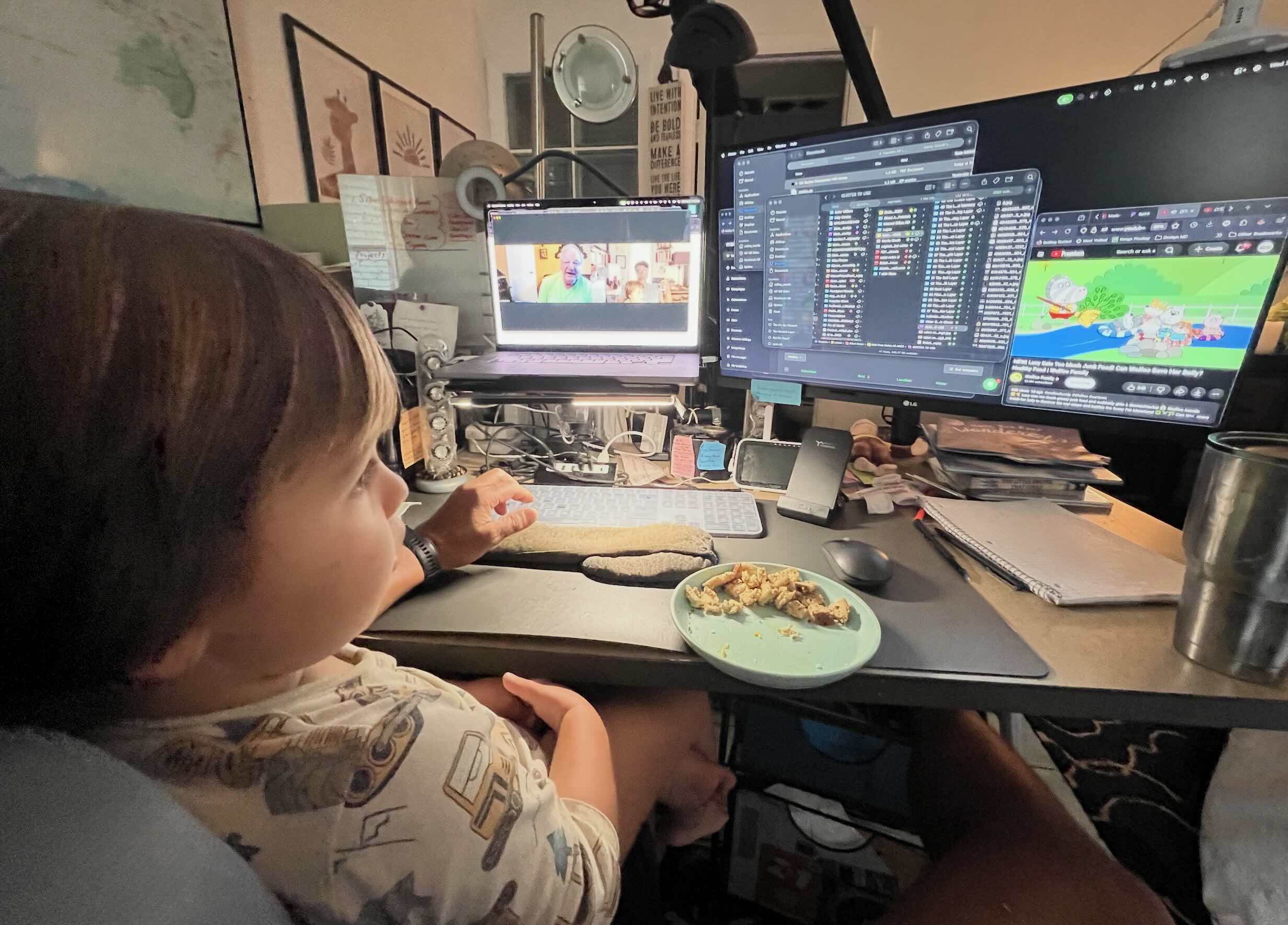
I have to name this because most flow writing was done by people who could book a cabin in the mountains or fly to a secluded island to finally write their book, and I'm doing this in a house with a toddler asking for me and a wife home at six.
The constraints haven't killed the flow. They've refined it. When you have four hours or less to disappear, you either actually disappear or you don't. There's no runway to fake it. My best sessions now are shorter and denser than my longest sessions ever were as a single guy in Miami. Because the door has to open on demand or the work doesn't happen.
If you're a busy person who's convinced flow isn't for you, this is the mirror. You don't need retreat. You need craft. And you need one door you're willing to walk through when the crack shows up.
Where Do You Go
Ask yourself the actual question.
What is the thing you make where you disappear into the making? Not the hobby you should have. The one where when it's happening, there is no you-shaped observer taking notes. Guitar. Coding. Cooking. Painting. Running. Client presentations when you're really cooking. A conversation with a specific friend when both of you enter the same field. What's the door?
You have one. Everyone does. Culture will tell you flow is a productivity hack for tech bros. It isn't. It's the ancient practice of letting the work play you for a while, and letting some old emotional charge leave through the making.
Retire the spotlight. Crave the disappearance. It played, not I played. The instrument only resonates the signal when the player is willing to vanish inside it. And when that happens, the spotlight has no choice but to find you.
Still here, playing what plays through. Same peel, letting it move through. Let's build from here. 🧅

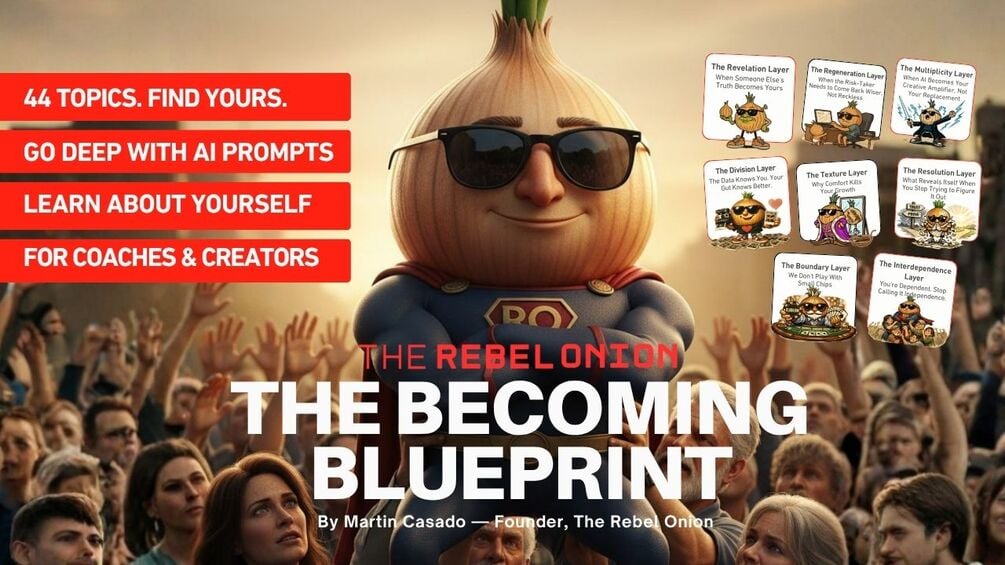
Want to write through these same layers and make them your own?
The "Being Coached" Layer: Same Name, Different Show
What you're describing with LLMs is what I call the training effect. It's just rewriting the same book with a new cover. Take the Perry Mason reboot. Erle Stanley Gardner wrote 82 Mason novels. Raymond Burr played him for nine years as a rock-solid defense attorney with his secretary Della Street and his investigator Paul Drake. They brought the series back, kept the names, changed everything else. Perry is a neurotic mess, the setting is gritty noir, and not one of the new episodes is even a Gardner story. It doesn't matter to the studio whether the remake matches the original. What matters is you already bought it because you were trained on the brand. Culture hones these consumer pathways so subtly you keep buying the new skin over the old frame.
As a dad, you're watching this same mechanism play out with your son from the other side. You're hyper-aware of how the world has changed and compressed. To him there are no changes. He only knows the world as it is right now. You can't teach him the difference because he doesn't have your reference point. Eventually you'll get the eye-roll and a "yeah, whatever," because he's building his own pathways, his own baseline, his own version of the story. Every generation gets trained on a new edition. The real work is spotting the difference between the timeless original signal and the repackaged noise.
The Takeaway for You: Stop expecting other people to see the world through your reference points. Recognize where you've been trained to buy a repackaged product, whether it's a media franchise, an AI output, or an old habit dressed in new language. Strip away the familiar label. Look at the substance underneath. Build your own pathways instead of consuming recycled ones.
Bookshelf Peeled - It Shoots
In Zen in the Art of Archery, Eugen Herrigel spends six years in 1930s Japan trying to learn archery under a Zen master. He's a German philosophy professor. Serious, disciplined, precise. And for six years he fails. He keeps trying to shoot the arrow. The master keeps telling him he's the problem. The famous line comes when Herrigel finally releases a shot without meaning to, and the master says quietly, "It shot." Not "you shot." It shot. The arrow released itself. The archer had become the instrument through which the shot happened. Everything before that was Herrigel getting in his own way with his own effort.
That is the whole physics of the instrument state. The moment you can genuinely say "it shot" instead of "I shot," you've disappeared into the making, and the making has done itself through you. Every art has this same threshold. The musician stops playing the song and the song plays itself through her. The designer stops designing and the design designs itself. The writer stops writing and the sentence arrives already assembled. Effort still happens, but ego is no longer holding the bow. Herrigel's master was pointing at what every tradition has pointed at forever. The self trying to be the one doing it is the exact obstacle to it being done.
The Takeaway for You: Stop trying to be the one shooting. Show up. Do your practice. Prepare the body, prepare the tools, prepare the room. Then let the effort you've built release itself through you. The arrow lands truer when you stop aiming so hard.
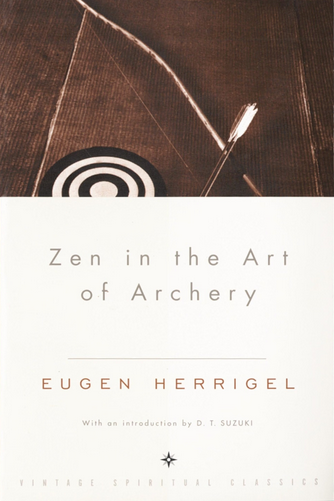
Zen in the Art of Archery
by Eugen Herrigel
Design Rebel: The Signal AI Can Never Replicate (Flow State)
This week was inspired by the concept of disappearing completely into your craft, realizing that flow isn't just a tool for productivity, but the last remaining source of unrecycled human signal in an distracted world.
Behind the Build: Bringing this visual concept to life required combining complex vintage aesthetics with vertical storytelling. The raw footage was generated across Leonardo.ai, Veo 3.1, and ElevenLabs, featuring dusty volumetric light, spinning projector sprockets, and a custom-built digital timer dissolve. Everything was precision-edited, color-graded, and timed in Wondershare Filmora to maintain the narrative pace.
This Got Me Thinking:
A good flow state explained by Steven Kotler.
P.S. If this resonates with you, share it with someone. I'm dedicated to helping fellow explorers—or anyone who found this page—uncover their authentic self with humor and insight. We're all in this together, finding the courage to truly live from our core essence (or as close as we can get!).
The Quiet Layer: Getting the Self Out of the Way
Fridays with Goodman: A striving artist, a Good-man and the Universal Principles at Play. by Martin Casado